
How is artificial insemination performed?
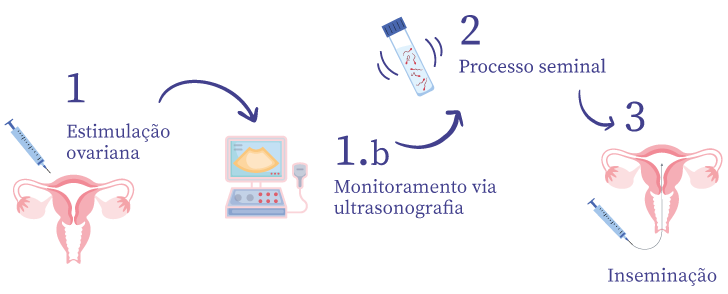
Intrauterine Insemination usually takes place in three stages: ovarian stimulation, semen processing, and the intrauterine insemination procedure itself.
TREATMENTS
Intrauterine InseminationIntrauterine Insemination, commonly referred to simply as Insemination, is a low-complexity assisted reproduction treatment that consists of placing motile sperm inside the uterine cavity during ovulation. Fertilization (the union of the sperm and the egg) occurs naturally in the fallopian tube, making any laboratory procedure for egg retrieval or manipulation unnecessary. Ovulation to enable the insemination process may occur through hormonal stimulation or even during a natural cycle (spontaneously).
Intrauterine Insemination usually takes place in three stages: ovarian stimulation, semen processing, and the intrauterine insemination procedure itself.
Artificial insemination may be the initial treatment for difficulty getting pregnant in the following situations:
At the beginning of the menstrual cycle, an ultrasound is performed to evaluate the ovaries and begin the medications that will stimulate the growth of follicles, which promote ovulation. In theory, an egg will develop inside the growing follicle. This entire process is monitored with serial ultrasound examinations so that we can have greater confidence that ovulation is approaching. When the largest follicle reaches an appropriate size, another medication (human chorionic gonadotropin – hCG) is administered to effectively trigger ovulation, which occurs 36 hours after hCG administration. The entire ovarian stimulation process until ovulation takes, on average, between 9 and 13 days.
Usually, two hours before the intrauterine insemination procedure, the semen is collected, generally through masturbation, and sent to the laboratory, where the seminal fluid is separated from the sperm and the highest-quality, most motile sperm are selected. Only the concentrated sperm sample will later be introduced into the uterine cavity.
The insemination is usually performed 24 to 36 hours after hCG administration and after semen collection and processing. Using a catheter, the prepared sperm solution is inserted into the uterine cavity after the catheter passes through the cervix. The semen sample is deposited 2 cm from the uterine wall.
The pregnancy rate with insemination is relatively low compared to the success rates of in vitro fertilization; however, cumulatively—that is, after multiple attempts—the outcomes can improve. Currently, success can be achieved in 15% to 20% of cases per cycle among women and people with a uterus under the age of 35. After the age of 35, the chances of success begin to decline progressively. Cumulatively (after 3 cycles), the success rate approaches 30% in the best cases. Studies conducted in Europe and the United States have shown that the take-home baby rate varies according to age, as shown in the table below:
| Woman’s age (years) | Under 32 | 32–35 | 35–37 | 38–39 | 40 or older |
| Take-home baby rate per cycle (%) | 14 | 12 | 9.7 | 6.1 | 2 |
| Take-home baby rate after 3 cycles (%) | 32 | 26.5 | 22 | 12.3 | 4.5 |
It is important to emphasize that this technique is not suitable for all cases. People with anatomical abnormalities of the fallopian tubes or significant semen abnormalities should not undergo this type of treatment.
©Copyright 2026 OrigenRio | Todos os direitos Reservados
by MG Studio
