
Transformando vidas e realizando sonhos

Agende sua consulta

Fertility Preservation

What is fertility preservation?

Fertility preservation is defined as the ability to freeze germ cells and tissues, such as sperm, eggs, ovarian tissue, and embryos, so that at a later time, under ideal circumstances, pregnancy can be planned through assisted reproduction techniques.

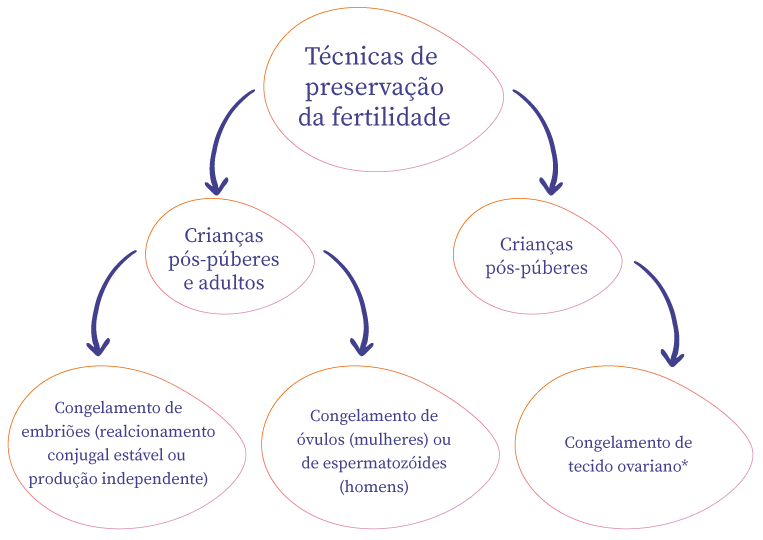
What can be preserved:

What are the indications?

Social

Many people have postponed motherhood and/or parenthood due to the need to achieve socioeconomic and relationship stability before having children. For personal reasons, they determine the best time to start a family, often when they already have an advanced biological age (ovarian reserve) for achieving successful pregnancy. In such cases, egg freezing is an excellent alternative for preserving this desire. The highest chances of pregnancy success using preserved eggs, for example, occur when the eggs were frozen before the age of 35, thereby reducing the risk of unsuccessful pregnancies at a more advanced age, when fertility potential is known to be lower.


Cancer patients

Chemotherapy and radiotherapy are often essential treatments to increase survival and reduce mortality in people with cancer. However, despite their benefits in treating cancer, these treatments may have toxic effects on the ovaries and testes, affecting fertility and potentially eliminating the possibility of future pregnancy, resulting in emotional and social consequences that may be irreparable. From this perspective, fertility preservation techniques emerge as a real alternative, allowing these individuals to have a baby in the future using their own sperm or eggs.

Surgeries or diseases that reduce fertility

Diseases classified as autoimmune (where the body’s own antibodies attack healthy cells), genetic disorders, endometriosis, and ovarian surgeries, among other causes, may lead to premature ovarian and testicular failure, causing the early cessation of egg and sperm production, respectively, which may be characterized as gonadal failure. Fertility preservation, before the disease progresses and before necessary procedures are performed, is an existing solution to support future family planning.

What techniques are used for fertility preservation?

  • Egg freezing

    The patient undergoes the same process as the first stage of the in vitro fertilization (IVF/ICSI) procedure. Ovulation is stimulated through medications that promote the growth of ovarian follicles, thereby producing the highest possible number of mature eggs, unlike what typically occurs in natural cycles. Afterward, the ovaries are punctured to retrieve the eggs using a fine needle guided by transvaginal ultrasound. This entire procedure is performed under anesthesia. After collection, the eggs are frozen (cryopreserved) in liquid nitrogen at a temperature of -196°C, preserving their characteristics and quality at that time so they can be thawed in the future.

  • Semen freezing

    Sperm is obtained through masturbation. If no sperm is present in the ejaculate, modern microsurgical techniques are used to extract sperm directly from the testicles so they can be cryopreserved and later thawed, thus preserving fertility.

  • Embryo freezing

    At this stage, the same process as the second phase of the in vitro fertilization (IVF) procedure is carried out. For embryo freezing, the individuals involved must undergo egg and/or sperm retrieval procedures, and all collected material is taken to the laboratory, where embryologists perform fertilization using the well-established ICSI (Intracytoplasmic Sperm Injection) technique. The resulting embryo is monitored throughout its development, and between the 5th and 6th day of embryonic development, it is frozen.

  • Ovarian and testicular tissue freezing

    Freezing ovarian tissue, as well as testicular tissue (still considered experimental), may represent the only fertility preservation option for children who have not yet reached puberty and will undergo cancer treatment, making it impossible to collect eggs and/or sperm. The technique involves removing a fragment of the ovary or testicle for freezing. After cancer treatment, the tissue can be thawed and transplanted back into the patient’s body.

  • Vitrification

    This is the name given to the most widely used and most advanced laboratory technique for freezing germ cells and tissues, such as sperm, eggs, ovarian tissue, and embryos. Vitrification is a rapid and safe cryopreservation method performed in liquid nitrogen at a temperature of -196°C, causing minimal impact on eggs, sperm, and embryos, thereby providing better freezing and thawing rates and ensuring the survival of the preserved material.

Frequently Asked Questions