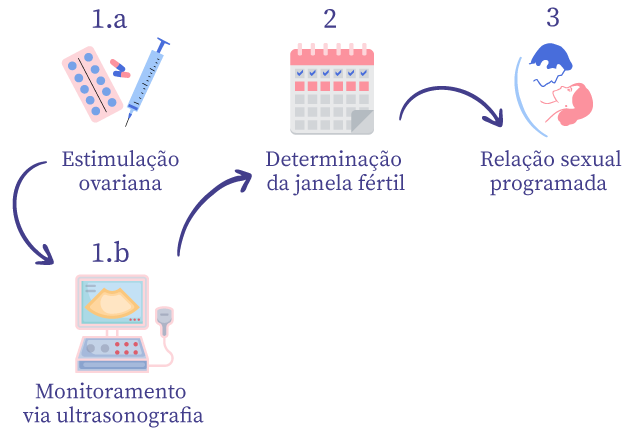
Having a more accurate understanding of the fertile window is essential for couples to succeed through timed intercourse. With this information, couples have a 15% to 20% chance of becoming pregnant per menstrual cycle in women and people with a uterus under the age of 35. After the age of 35, the chances of success progressively decline. It is important to remember that anatomical abnormalities and functional disorders of the fallopian tubes and uterus prevent the use of this technique, as do significant abnormalities in the semen analysis.
Ovarian hyperstimulation is considered a rare complication in fertility treatments. It consists of an exaggerated response of the ovaries to the hormonal stimulation used. However, this condition is more common in high-complexity treatments (in vitro fertilization), where higher doses of ovulation-inducing medications are used, and even then, it represents only 1–2% of cases.
Another possible outcome of this type of treatment is multiple pregnancy (twins or more). If more than one follicle develops during ovarian stimulation and releases more than one egg, twin or even triplet pregnancies may occur. To reduce this possibility, timed intercourse is suspended in such cases. These measures are intended to reduce the risks associated with pregnancies involving more than one fetus.